

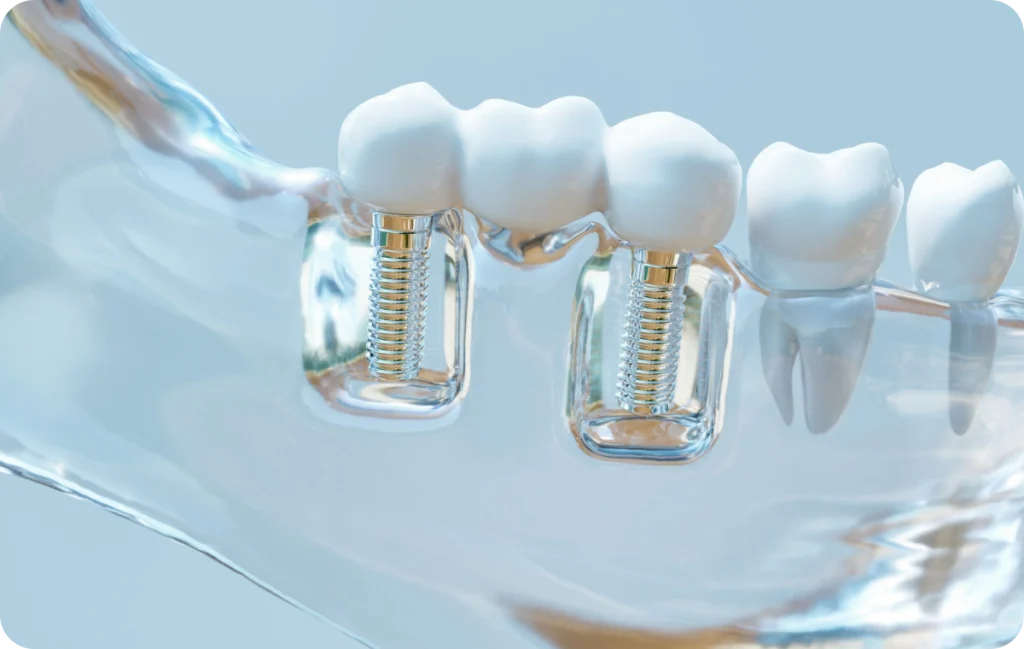
Crowns and bridges on implants are solutions used to replace one or more missing teeth in a fixed manner. They rest on dental implants, which serve as artificial roots inserted into the jawbone. Once stabilized, these implants support a custom-designed dental prosthesis.
The crown on implant allows for the replacement of a single missing tooth. It reproduces the appearance and function of a natural tooth while integrating harmoniously with the rest of the dentition.
The bridge on implant is indicated when several adjacent teeth are missing. It generally rests on two implants, between which several artificial teeth are joined. These devices aim to restore chewing, speech, and oral balance while contributing to the preservation of bone structures.
Why Consider a Crown or Bridge on Implant?
The Consequences of Tooth Loss
The loss of a tooth is not limited to an aesthetic concern. In the medium and long term, it can lead to progressive displacement of neighboring teeth, changes in occlusion, and overloading of certain areas during chewing. Additionally, the bone beneath the missing tooth tends to resorb when it is no longer stimulated.
These changes can impact daily comfort as well as overall oral health. This is why replacing missing teeth plays an important role in preventing oral imbalances.
The Advantage of Implant Support
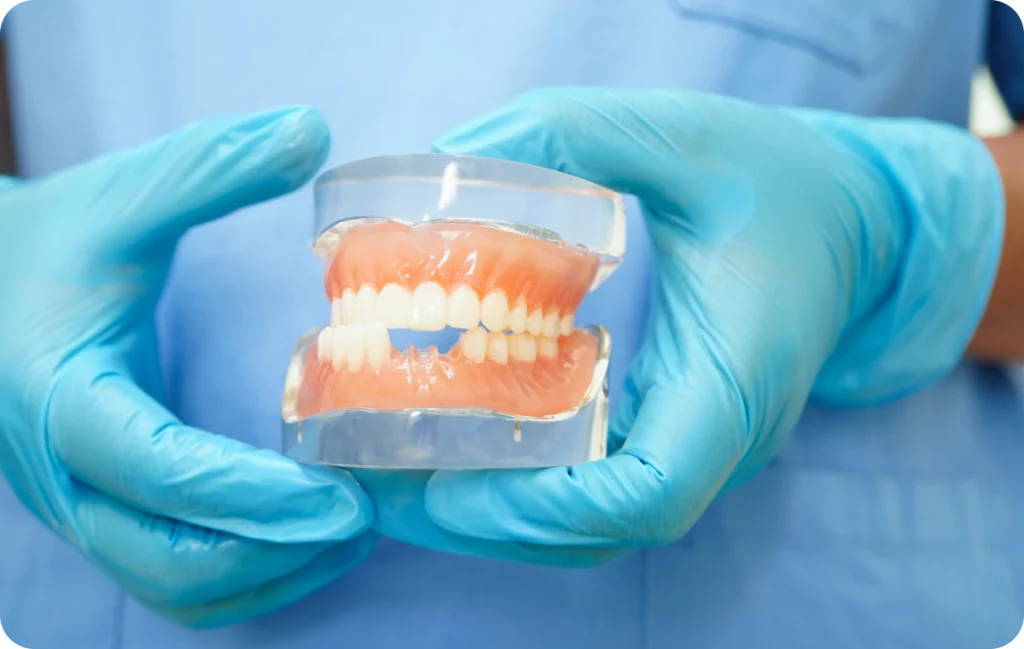
Crowns and bridges on implants restore stable dentition without affecting adjacent teeth. Unlike conventional bridges, they do not require trimming neighboring teeth, which preserves existing dental tissue.
The implant transmits masticatory forces to the bone, thereby contributing to its preservation over time. This bone stimulation helps maintain a harmonious jaw structure.
Difference Between Crown on Implant and Bridge on Implant
The Crown on Implant
The crown on implant is indicated when a single tooth is missing. It consists of three elements: the implant inserted into the bone, the prosthetic abutment that provides the connection, and the visible crown in the mouth. Each component is designed to function in a complementary manner.
This solution allows for targeted restoration while providing a sensation similar to that of a natural tooth during chewing.
The Bridge on Implant
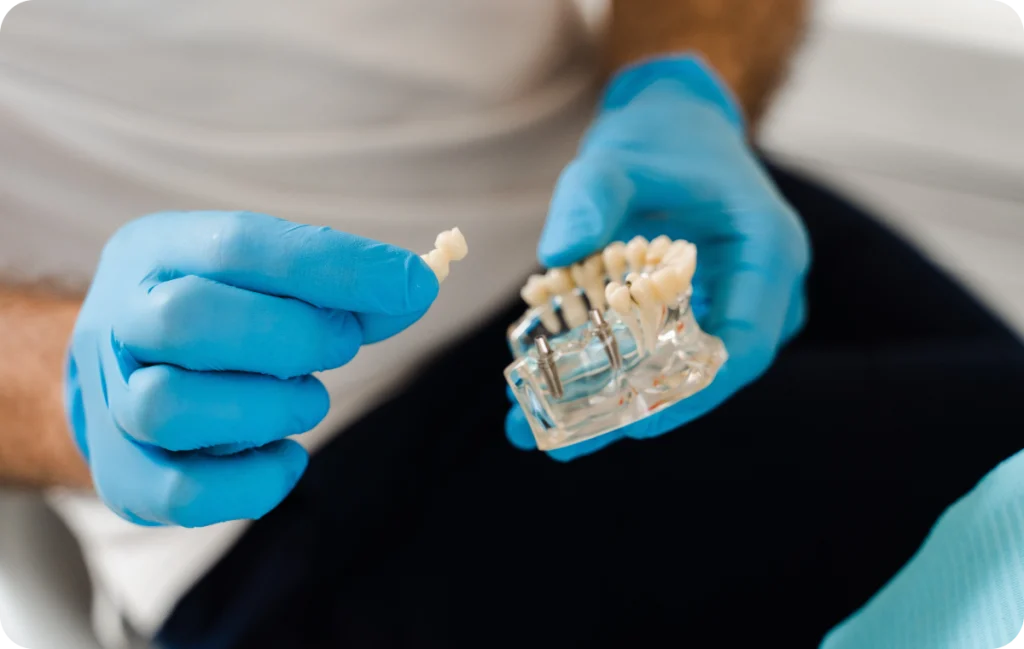
The bridge on implant is intended for situations where several consecutive teeth are missing. It rests on a limited number of implants, generally placed at the ends of the edentulous area. The intermediate teeth are joined to the prosthetic assembly.
This approach restores an extended area while ensuring proper distribution of forces. The choice between crown and bridge on implant always depends on a personalized analysis.
The Treatment Steps for Crowns and Bridges on Implants
Initial Assessment
Treatment begins with a thorough consultation. The dentist performs a complete clinical examination, combined with medical imaging. These elements allow for the evaluation of bone quality, the position of anatomical structures, and the functional constraints specific to each patient.
Implant Placement
Implant placement is performed under local anesthesia. The procedure involves inserting the implant into the jawbone under appropriate comfort conditions. After this step, a healing phase is necessary to allow for osseointegration, that is, the permanent fixation of the implant to the bone. This period varies depending on clinical situations and may last several weeks to several months.
Prosthesis Placement
Once the implant is stabilized, impressions are taken to design the crown or bridge on implant. The prosthesis is custom-made to fit precisely to the patient’s oral morphology. It is then securely fixed, allowing for gradual resumption of masticatory function.
Materials Used for Crowns and Bridges on Implants
Crowns and bridges on implants can be made from different materials, chosen according to tooth location, mechanical constraints, and aesthetic expectations.
Ceramic is often used for its ability to faithfully reproduce the natural appearance of the tooth. It offers good visual integration, particularly in anterior areas. Zirconia is also commonly used due to its strength and light shade.
In some cases, structures combining metal and ceramic may be proposed, particularly for posterior areas subject to greater masticatory forces.
Maintenance and Follow-up of Crowns and Bridges on Implants
The importance of oral hygiene
Although crowns and bridges on implants are not subject to cavities, the surrounding tissues require particular attention. Insufficient hygiene can promote inflammation around the implant.
Careful brushing, supplemented by the use of interdental brushes or appropriate dental floss, helps maintain good health of peri-implant tissues. These practices are part of a simple and effective daily routine.

Regular Follow-up
Regular check-ups with the dentist allow for verification of implant stability and the condition of the prostheses. These appointments provide an opportunity to adjust maintenance and prevent potential complications.
Who Are Crowns and Bridges on Implants For?
Crowns and bridges on implants are primarily intended for adults with one or more missing teeth. An essential condition is the presence of sufficient bone volume to accommodate the implant. When this volume is insufficient, complementary solutions may be considered before implant placement.
Certain medical situations require careful evaluation in order to adapt the treatment. A thorough discussion with the practitioner determines the feasibility of the treatment and allows for consideration of alternatives if necessary.
Daily Comfort with an Implant Solution
Once in place, crowns and bridges on implants offer appreciable stability in daily life. They allow for chewing, speaking, and smiling without particular constraints. Their permanent fixation avoids the movements or friction sometimes experienced with removable solutions.
Their personalized design contributes to a harmonious result, both functionally and aesthetically, promoting natural integration into daily life.
FAQ – Crowns and Bridges on Implants
- Is Implant Placement Painful?
The procedure is performed under local anesthesia. Post-operative effects are generally moderate and well managed through appropriate recommendations. - How Long Does Implant Treatment Take?
The duration depends on bone healing. It most often extends over several months, between implant placement and fixation of the final prosthesis. - Is a Crown on Implant Visible?
It is designed to integrate naturally with existing dentition, both in shape and color. - Can Several Teeth Be Replaced with Few Implants?
Yes, the bridge on implant allows for the replacement of several missing teeth by resting on a limited number of implants. - Does an Implant Require Special Follow-up?
Regular follow-up is recommended to monitor implant stability and the health of surrounding tissues.
Schedule an Appointment for an Implant Project in Cagnes-sur-Mer
If you wish to evaluate the possibility of replacing one or more missing teeth, a consultation allows for the examination of your situation and answers to your questions. The Dental Office of Doctors Payam and Pegah Gandjizadeh in Cagnes-sur-Mer accompanies you in this process and informs you about solutions adapted to your situation. You can now schedule an appointment online to discuss with the team and confidently consider your treatment project.