

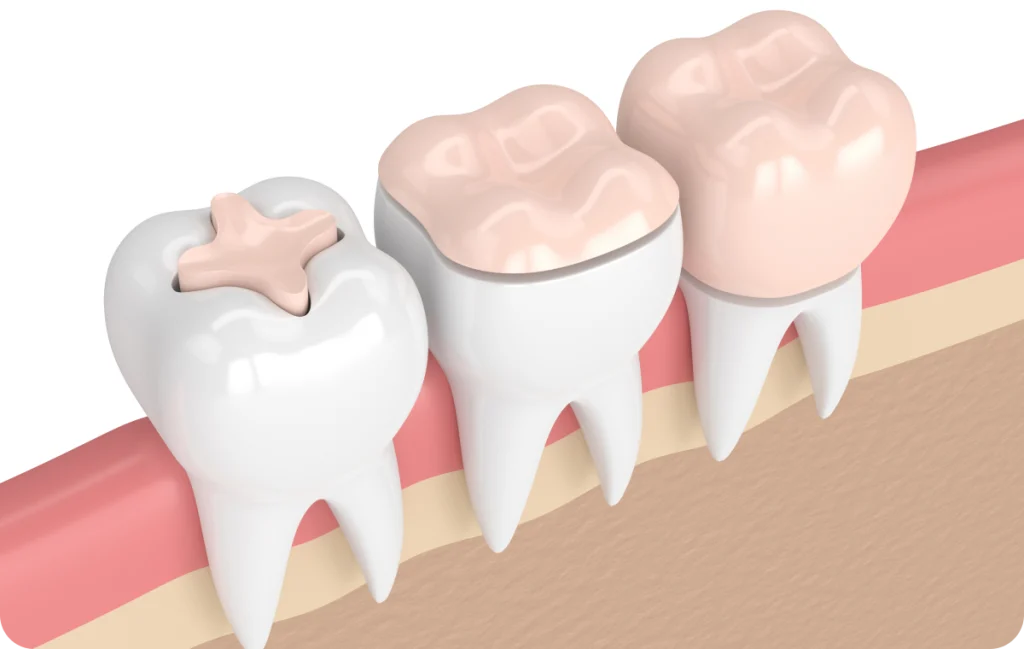
An Inlay / Onlay is a dental restoration designed to repair a tooth with moderate to significant substance loss. This solution falls between a conventional filling and a dental crown. It allows for precise restoration of the tooth while preserving a significant portion of the natural structure.
Unlike restorations performed directly in the mouth, the Inlay / Onlay is custom-made from an impression of the prepared tooth.
This indirect design allows for a piece perfectly adapted to the dental morphology, both functionally and morphologically.
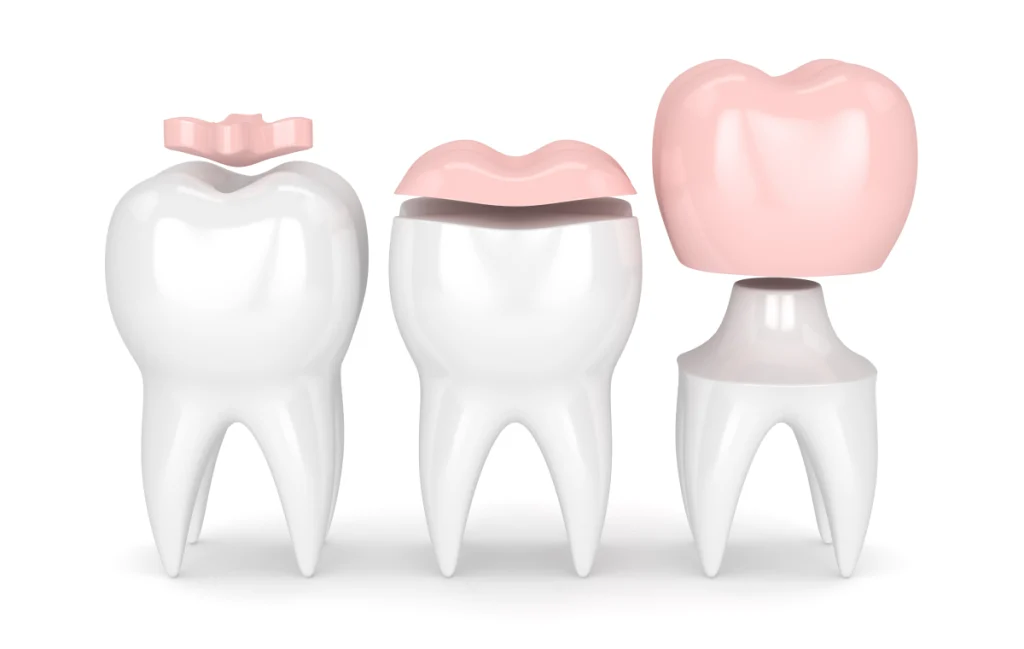
Two types of restorations are distinguished. The Inlay is positioned inside the tooth, without covering the external reliefs. The Onlay, on the other hand, extends over one or more cusps to reinforce a weakened tooth. The choice depends on the extent of the lesion and the remaining strength of the tooth.
In which cases can an Inlay / Onlay be considered?
An Inlay / Onlay is generally recommended when the tooth is too damaged to receive a simple filling, but sufficiently preserved to avoid a complete crown. This situation is frequently encountered after treatment of an extensive cavity. It may also be indicated when replacing old restorations that have become unsuitable.
Over time, certain materials may lose their seal or develop microcracks. In this context, the Inlay / Onlay allows for reliable restoration of the tooth while respecting the remaining dental tissues.
In certain cases, this restoration is also used after endodontic treatment. The tooth, weakened by the loss of internal tissue, can then benefit from partial reinforcement through an Onlay, to better withstand masticatory forces.
Differences between Inlay and Onlay
The Inlay
The Inlay is designed to restore the interior of the tooth. It fits precisely into the cavity prepared after removal of the cavity or old restoration. This solution is indicated when the cusps are intact and sufficiently resistant.
It allows for respect of the dental anatomy while ensuring proper adaptation to the tooth walls. This precision contributes to comfortable chewing and good stability over time.
The Onlay
The Onlay is used when the tooth presents more extensive weakening. It covers one or more cusps to protect the tooth against forces exerted during chewing. This configuration allows for better distribution of stress and limits the risk of fracture.
The choice between Inlay and Onlay is based on a thorough clinical examination. It takes into account the amount of remaining dental tissue, the position of the tooth in the arch, and its functional role.
Materials used for an Inlay / Onlay
Several materials can be used for the fabrication of an Inlay / Onlay. The choice depends on the clinical situation, the tooth concerned, and functional constraints. Ceramic is frequently used. It offers good wear resistance and stability over time. Its appearance, similar to natural enamel, promotes harmonious integration into the dentition.
Indirect composite constitutes another alternative. It offers good adaptation and a certain flexibility, which may be indicated in certain clinical situations. This material also allows for discreet restoration.
In more specific cases, metal alloys may still be considered. However, their use remains more limited today. The choice of material is always the subject of prior discussion, in order to adapt the restoration to the patient’s functional needs.
Procedure for placing an Inlay / Onlay
The creation of an Inlay / Onlay generally requires two appointments. During the first session, the tooth is prepared after removal of affected tissues. This step aims to create a cavity with precise contours, allowing optimal adaptation of the future restoration.
An impression is then taken, either conventionally or by digital impression. This impression is used for the custom fabrication of the Inlay / Onlay. A temporary restoration is placed to protect the tooth and ensure patient comfort between sessions.
During the second appointment, the final piece is tried in. The practitioner verifies its adaptation, contact points, and occlusion. Once these checks are completed, the Inlay / Onlay is bonded durably. Bonding plays an essential role in the strength of the tooth-restoration assembly.
Sensations and adaptation after placement
After placement, an adaptation period may be necessary. The majority of patients quickly regain natural sensations during chewing. The restoration is adjusted to respect occlusion and contacts with neighboring teeth.
Slight transient sensitivity may sometimes appear, particularly during temperature variations. These sensations generally disappear within a few days. In case of persistent discomfort, a check-up allows for adjustment of the restoration if necessary. Thanks to its custom design, the Inlay / Onlay integrates harmoniously into the dentition and fully participates in masticatory function.
Daily maintenance and hygiene
Maintenance of an Inlay / Onlay is based on rigorous oral hygiene. Careful brushing, at least twice a day, helps limit plaque accumulation around the restoration.
The use of dental floss or interdental brushes is recommended to effectively clean contact areas. These practices help prevent the appearance of secondary cavities and maintain gum health. Regular check-ups with the dental surgeon allow for monitoring the condition of the restoration and ensuring appropriate follow-up over time.

Longevity and regular follow-up
The lifespan of an Inlay / Onlay depends on several factors, such as oral hygiene, dietary habits, and mechanical stress exerted on the tooth. A well-maintained restoration can remain functional for many years.
Posterior teeth, more stressed during chewing, require particular monitoring. Regular follow-up allows for early detection of any changes and intervention if needed. The Inlay / Onlay is thus part of a conservative approach aimed at preserving the natural tooth for as long as possible.
FAQ – Inlay / Onlay
- Is an Inlay / Onlay painful?
Placement is performed under local anesthesia, which allows for painless work. The aftermath is generally straightforward. - How long does it take to create an Inlay / Onlay?
Fabrication generally requires a few days between the two appointments. - Can one eat normally after placement?
After final placement, chewing resumes gradually according to the recommendations provided. - Does the Inlay / Onlay require special maintenance?
It is maintained like a natural tooth with daily hygiene and regular check-ups. - Is this a visible restoration?
The materials used allow for discreet integration, particularly for visible teeth.
Schedule an appointment for an Inlay / Onlay in Cagnes-sur-Mer
For any questions or to evaluate the most suitable solution for your situation, consultation with a dental health professional is recommended. The Dental Office of Doctors Payam and Pegah Gandjizadeh in Cagnes-sur-Mer welcomes you and offers online appointment scheduling to easily organize your consultation and treatment follow-up.